Transform Data Center Security Into Verifiable Proof
Table of Contents
- 1.A policy document is not proof
- 2.How we turn trust into proof
- 3.What your customers actually get
- 4.Monitoring tells you something broke. Proof tells you it did not.
- 5.Who needs this - and why
- 6.Where to start
- 7.Proven, not theoretical
TL;DR: Stop claiming your data center is secure. Prove it continuously, with signed evidence your customers and auditors can verify themselves.
Regional and SME data centers already invest heavily in infrastructure, compliance, and operational security. The harder problem is proving that trust clearly enough for customers handling regulated, sensitive, or high-value workloads.
TeyzSec closes that gap with InfraGuard: a practical trust layer that turns hardware state, runtime integrity, workload placement, and drift into evidence customers can inspect instead of promises they have to accept.
A policy document is not proof
A security policy says what should happen. A certificate says what was reviewed. Neither proves that a specific workload ran on a genuine, untampered machine at a specific point in time. That proof matters when the customer is a bank, hospital, defense supplier, AI company, or telecom operator. They are not only asking whether your data center is secure. They are asking whether you can show evidence when it matters. Think of a hotel safe. The staff may have a master key to the room, but the safe is yours, and a tamper sticker proves no one opened it. InfraGuard is that tamper sticker for your servers: proof of what happened, that anyone can check. Key Points:
- Customers want proof, not only claims.
- Trust has become a commercial requirement, not just a technical one.
- The strongest message is simple: here is the evidence, verify it yourself.
How we turn trust into proof
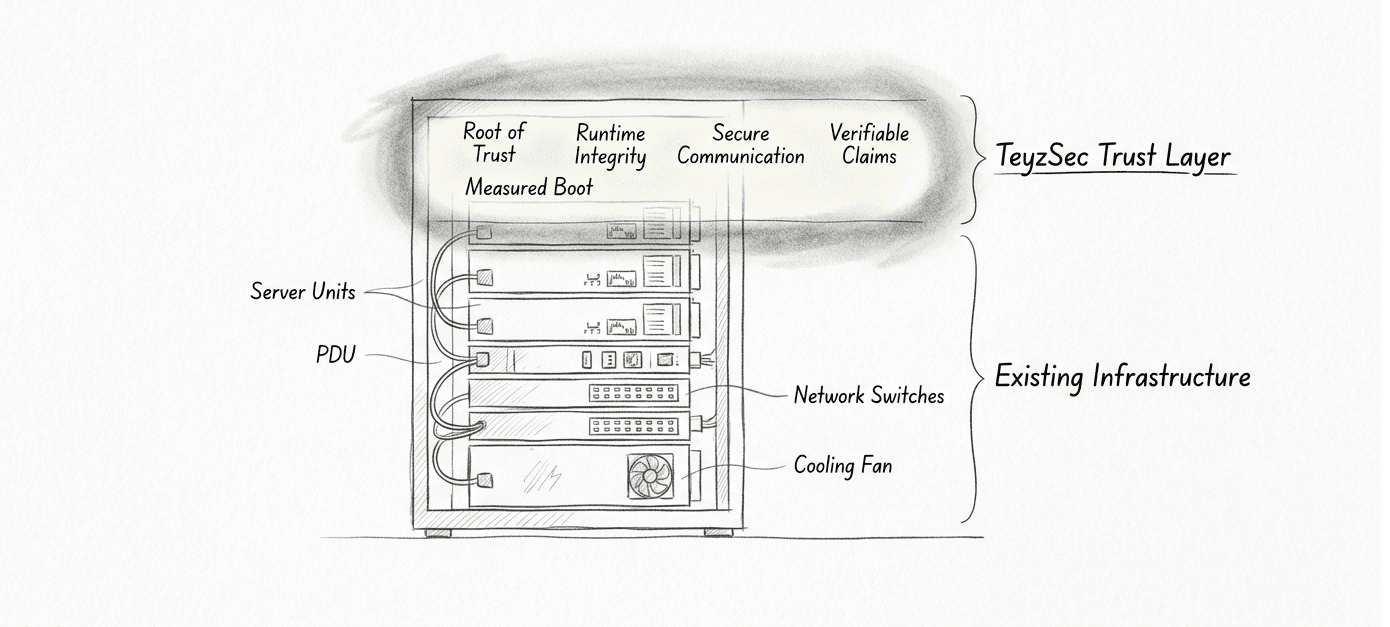
InfraGuard adds a trust layer on top of the hardware you already run. It uses the security chip (TPM) built into every server to continuously check each machine - at boot and while running - and confirms whether it is genuine, untampered, and in its approved state. The result is not a dashboard you have to trust. It is signed, tamper-evident evidence: a cryptographic record that any customer, auditor, or third party can verify on their own. You are not asking them to believe you. You are handing them proof. For workloads that need it, InfraGuard goes further. Confidential VMs and secure enclaves keep data protected even from the machine operator, and InfraGuard proves that protection held. Key Points:
- TPM-backed checks confirm the machine state.
- Continuous attestation catches drift while systems are running.
- Signed evidence lets third parties verify trust without trusting your word.
What your customers actually get
- A live view of every machine's trust state: trusted, degraded, blocked, or stale.
- Signed JSON evidence bundles and human-readable PDF reports.
- Which workload ran on which machine, in what state, and when.
- An alert the moment a machine drifts out of its approved state.
- A tenant-scoped view where each customer sees only their own machines.
Monitoring tells you something broke. Proof tells you it did not.
Traditional monitoring is useful, but it usually starts after something changes. Logs, alerts, and dashboards tell operators where to investigate. They do not automatically prove that a customer's workload stayed on an approved host. InfraGuard changes the question from "what happened after the alert?" to "can this machine prove it is still trusted right now?" We check every machine continuously and tell you the moment one drifts. That turns security into a customer-facing asset. Instead of saying your controls are strong, you can show signed evidence that the workload ran where it should, when it should, and under the right conditions. Key Points:
- Monitoring helps teams react.
- Proof helps customers and auditors verify.
- Continuous checking makes drift visible before it becomes a trust problem.
Who needs this - and why
Trusted compute matters most where sensitive data, regulation, or operational risk decides who wins the workload.
- Finance needs proof for payment systems, trading workloads, fraud models, and regulated customer data.
- Healthcare needs evidence that patient data and clinical workloads ran in controlled environments.
- Defense needs stronger assurance for classified, sensitive, or supply-chain exposed systems.
- Telecom needs trust across distributed infrastructure, edge sites, and critical network functions.
- AI teams need confidence that training, inference, and proprietary models ran on approved machines.
For regional and SME data centers, this is a practical opening. Large providers compete on scale. Smaller providers can compete on trust that customers can verify.
Where to start
Start with the workloads that carry the most risk: regulated customer environments, tenant-isolated clusters, AI workloads, payment systems, or anything tied to a compliance deadline. Do not try to convert the whole estate on day one. Prove one high-value path first: machine attestation, workload placement, drift detection, customer report. Once that path works, expand to more clusters, tenants, and operating environments. The goal is not to add another dashboard. The goal is to make trust operationally useful and commercially visible. Key Points:
- Start with your most sensitive workloads.
- Prove one lifecycle before expanding.
- Use trust evidence in operations, audits, and sales conversations.
Proven, not theoretical
InfraGuard has been validated end to end on real server hardware and real Kubernetes environments through a machine's full lifecycle: trusted -> tampered -> blocked -> alerted -> signed report. That lifecycle is the difference between a security concept and a customer-ready proof system. It shows that the platform can detect drift, enforce the trust boundary, create evidence, and explain the result in a format people can use. Not a lab slide. The real path.
Conclusion
Regional and SME data centers that can prove trust will win the regulated customers everyone else is locked out of: finance, healthcare, defense, telecom, and AI. Those still relying on "trust us" will keep losing those deals.
The gap is not security. It is proof.
Related Content
Latest Posts
External Resources
- - NIST Cybersecurity Framework: https://www.nist.gov/cyberframework
- - NIST Zero Trust Architecture: https://www.nist.gov/publications/zero-trust-architecture
- - Trusted Computing Group TPM 2.0: https://trustedcomputinggroup.org/resource/tpm-library-specification/
- - CISA Resources: https://www.cisa.gov/resources-tools
Frequently Asked Questions
Q:What does InfraGuard prove for a data center?
A:InfraGuard proves whether a machine is genuine, untampered, and in its approved state when sensitive workloads run on it. It turns trust into signed evidence instead of a provider promise.
Q:How does the proof work?
A:InfraGuard uses TPM-backed attestation, runtime integrity checks, workload correlation, and signed evidence bundles that customers, auditors, or third parties can verify independently.
Q:Does this require replacing existing infrastructure?
A:No. InfraGuard is designed to add a trust layer to hardware and environments operators already run, including Kubernetes, bare-metal, and supported confidential computing deployments.
Q:What does a customer actually receive?
A:A customer can receive a live trust view, signed JSON evidence, a human-readable PDF report, drift alerts, and tenant-scoped access to only the machines and workloads relevant to them.
Q:Where should a data center start?
A:Start with the most sensitive or commercially important workload, prove the full lifecycle from trusted state to drift alert and signed report, then expand across more tenants and clusters.