Confidential Computing on the Factory Floor
Table of Contents
- 1.Importance of Confidential Computing in Manufacturing
- 2.Key Concepts and Terminologies
- 3.Current Challenges in Secure Contract Manufacturing
- 4.Effective Methods for Secure Provisioning and Testing
- 5.Foundational Principles of Trustworthy Device Manufacturing
- 6.Best Practices for Protecting Firmware and Keys
- 7.Improving Operational Efficiency with Secure Factory Workflows
Confidential computing is becoming increasingly important for protecting firmware, device identities, and production keys in outsourced manufacturing environments. As more hardware production shifts to third-party factories, organizations need stronger ways to secure sensitive data, prevent IP leakage, and ensure that devices are tested and provisioned in a trusted manner.
This article will explore the key aspects of confidential computing in factory-floor environments, including core concepts and terminology, the main security challenges in contract manufacturing, and practical methods for building secure provisioning and test workflows. By examining the foundational principles and best practices, it aims to provide a clear framework for protecting device firmware, preserving intellectual property, and improving trust across the manufacturing supply chain.
Importance of Confidential Computing on the Factory Floor
Confidential computing is becoming essential for protecting firmware, device identities, and provisioning secrets in outsourced manufacturing environments. As more hardware production is handled by third-party factories, organizations need stronger controls to prevent IP leakage, unauthorized cloning, and exposure of production credentials. A well-defined confidential computing approach helps align security with manufacturing goals, ensuring that sensitive assets remain protected while devices are tested, programmed, and validated on the factory floor. It also supports trust between OEMs and manufacturers by reducing reliance on blind trust and increasing cryptographic assurance.
Key Concepts and Terminologies
Understanding the core concepts behind confidential computing is important for designing secure factory workflows. Terms such as secure boot, root of trust, device attestation, hardware security module, secure element, and encrypted key provisioning are central to building trusted manufacturing pipelines. In this context, confidential computing refers to performing sensitive operations in protected environments so that even infrastructure operators cannot view the underlying secrets. Related terms such as device provisioning, test firmware, end-of-line testing, and production key injection are also important for understanding how secure manufacturing systems operate.
Current Challenges in Secure Contract Manufacturing
Organizations face several challenges when manufacturing devices through external partners. One major issue is that production firmware, keys, or device identities may be exposed during testing or programming, creating opportunities for IP theft, reverse engineering, or unauthorized overproduction. Another challenge is the lack of visibility into what happens on the factory floor. Without strong cryptographic controls and auditable workflows, OEMs may not know whether the correct firmware was loaded, whether the right serial number was assigned, or whether extra units were produced outside the approved contract.
Effective Methods for Secure Provisioning and Testing
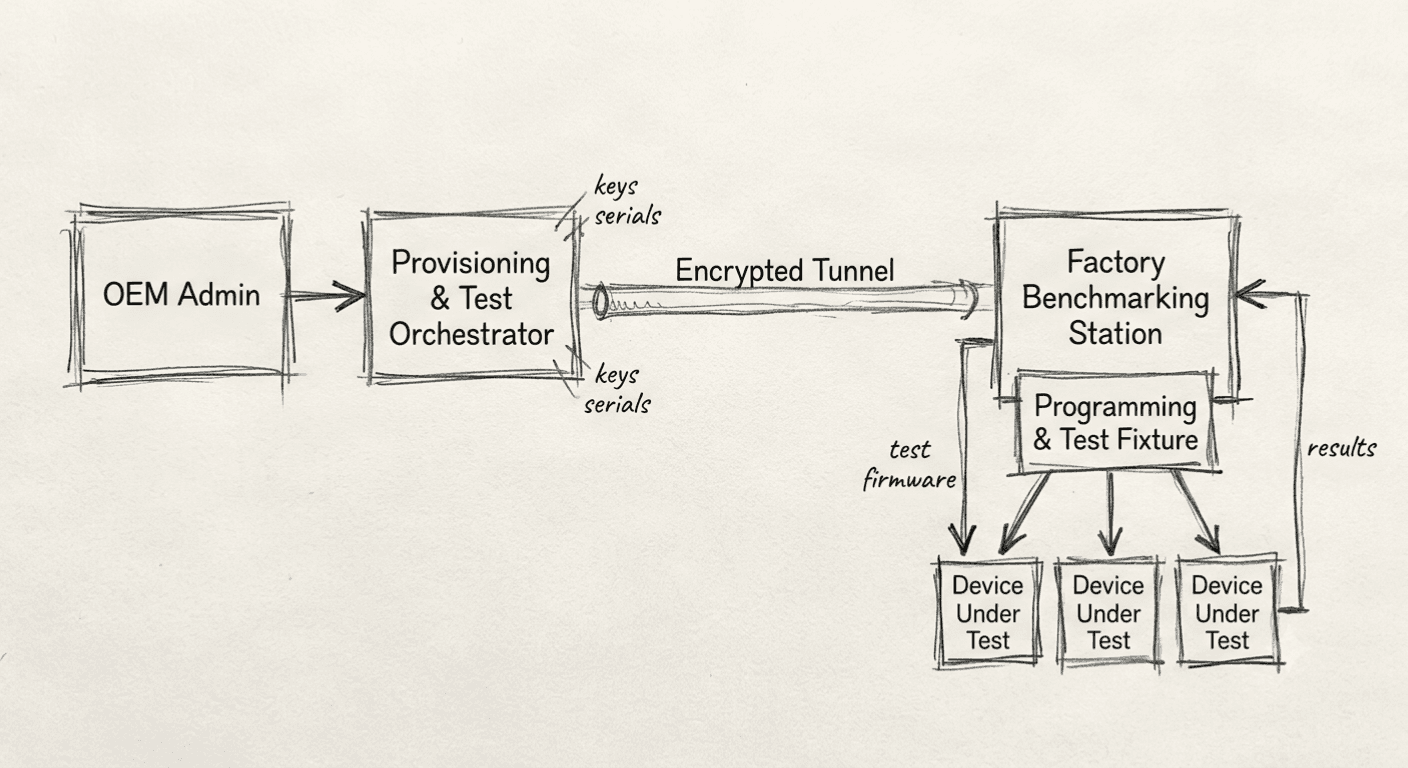
Implementing secure manufacturing workflows requires a layered approach that combines encrypted communication, trusted hardware, and strict identity control. One effective method is to keep the OEM in control of key generation and provisioning, while the factory only receives the minimum information needed to perform testing and assembly. Another important method is to separate test firmware from production firmware. The factory can use limited test code for validation, while the final production image is delivered only after checks are complete. Secure tunnels, attestation, and hardware-backed key storage can further strengthen the provisioning process and reduce exposure to third-party operators.
Foundational Principles of Trustworthy Device Manufacturing
The foundation of confidential computing on the factory floor rests on confidentiality, integrity, and availability. Confidentiality ensures that firmware, keys, and serials are never exposed in cleartext to untrusted parties. Integrity ensures that the correct firmware and provisioning data are used throughout the process. Availability ensures that manufacturing operations can continue without unnecessary friction or downtime. These principles help organizations design workflows that protect sensitive assets while still supporting efficient production at scale.
Best Practices for Protecting Firmware and Keys
Adopting best practices is critical for building a secure manufacturing framework. One key practice is to use hardware roots of trust, secure elements, or trusted execution environments so secrets are never handled in plain form on factory systems. Another best practice is to implement per-device traceability with strong logging and attestation. That way, each device can be tied to a verified provisioning event, test result, and firmware version. Limiting factory access, using encrypted channels, and separating test from production environments also help reduce risk.
Improving Operational Efficiency Through Secure Factory Workflows
Confidential computing can improve operational efficiency by reducing the risk of rework, fraud, and security incidents. When provisioning and testing are designed with clear controls, OEMs gain better visibility into device status and can make faster go/no-go decisions. It can also streamline operations by enabling automated verification and remote oversight. Instead of relying on manual checks and informal trust, organizations can use cryptographic proofs, logged results, and secure workflows to maintain both speed and control across the manufacturing process.
Conclusion
The TeyzSec approach marks an important shift from conventional manufacturing trust models to a more secure, cryptographically verified factory workflow. By applying confidential computing principles to provisioning and testing, organizations can better protect firmware, keys, and device identities while reducing the risk of IP leakage, counterfeit production, and unauthorized access.
To implement this approach effectively, organizations should assess their current manufacturing and provisioning pipeline, introduce hardware-backed trust and secure key handling, and build a clear policy for testing, logging, and attestation. A secure factory floor is not just about stronger controls; it is about creating a trustworthy production process that supports scale, resilience, and long-term confidence.
Related Content
Latest Posts
External Resources
- [NIST Hardware-Enabled Security / Confidential Computing]: https://csrc.nist.gov/pubs/ir/8320/d/ipd
- [NIST Cybersecurity]: https://www.nist.gov/cybersecurity
- [MITRE ATT&CK for ICS]: https://attack.mitre.org/matrices/ics/
- [OWASP IoT Security Testing Guide]: https://owasp.org/owasp-istg/
Frequently Asked Questions
Q:What is the TeyzSec approach to trusted compute?
A:The TeyzSec approach applies confidential computing to factory-floor provisioning and testing, so firmware, keys, and device identities stay protected even in outsourced manufacturing. It combines hardware-backed trust, encrypted workflows, and per-device auditability to reduce IP leakage and improve trust in production.
Q:How can organizations implement the TeyzSec model for their infrastructure?
A:To implement the TeyzSec model, organizations should assess their manufacturing and provisioning flow, then add hardware-backed protection for secrets, secure boot, and attestation at the points where devices are programmed and tested. They should also define a secure key-management process and tightly control what the contract manufacturer can see or handle.
Q:What are the main challenges when shifting to a trusted compute architecture?
A:A major challenge is integrating trusted computing into existing factory workflows without disrupting production. Another challenge is protecting machine identities and keys during use, since they are often vulnerable in memory or during provisioning if the environment is not tightly controlled.
Q:What best practices should I follow when adopting the TeyzSec approach?
A:The best practices are to perform a risk assessment, separate test firmware from production firmware, use hardware roots of trust, and keep keys in secure hardware or protected provisioning systems. It is also important to maintain logging, attestation, and regular updates to both hardware and software.
Q:How will trends in AI impact the future of trusted compute architectures like TeyzSec?
A:AI will likely improve anomaly detection, automated response, and monitoring across factory-floor trusted compute systems. As confidential computing matures, AI-driven controls can help identify suspicious provisioning behavior faster and strengthen the overall trust chain.